
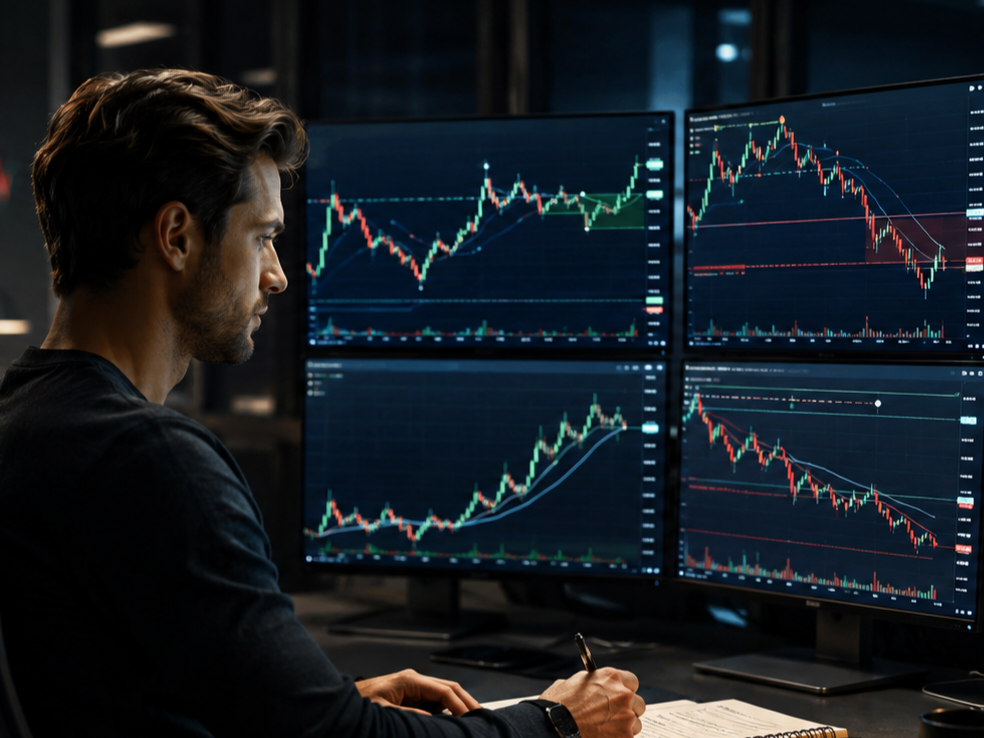
Day trading attracts many people because it gives the impression that everything can happen quickly: one position, one move, one profit, then another opportunity a few minutes later. On paper, it can look simple. In reality, that speed is exactly what makes day trading difficult. The market does not leave much time to think. It puts the trader face to face with reflexes, emotions, discipline, and the ability to follow a plan.
The difference between a trader who improves and a trader who burns out does not only come from the choice of an indicator or a platform. It comes mostly from the way decisions are made. Some traders build a method. Others react to every candle as if it were an emergency. That is often where everything changes.
The number one problem: trading with emotions
Fear and greed are two powerful forces in trading. Fear can push a trader to close a position too early, avoid a valid opportunity, or exit as soon as the market pulls back slightly. Greed can push a trader to stay too long, increase position size after a win, or keep chasing “just a little more” even when the original plan clearly said to exit.
The problem is that the market rarely rewards emotional improvisation. A trader can be right about an idea and still lose money because the entry is too late, the exit is too early, the risk is increased after a loss, or the scenario is changed in the middle of the trade.
Managing emotions does not mean feeling nothing. Every trader feels something: stress, doubt, impatience, frustration, excitement. The real difference is not allowing those emotions to control the buy or sell button.
A strategy is not optional. It is protection.
Many beginner traders look for the “right signal.” But a signal alone is not enough. A complete strategy must answer several simple but essential questions:
- Why am I entering this position?
- At what exact moment am I entering?
- What would invalidate my scenario?
- Where will I take profit?
- Where will I cut the loss?
- How much am I willing to risk on this position?
Without those answers, the trader does not really have a strategy. The trader has an intention. And an intention is not enough when price accelerates, reverses, or creates a false signal.
A good strategy does not guarantee a profit. It gives structure. It allows the trader to repeat the same logic, measure the results, and decide whether the method deserves to be kept, adjusted, or abandoned.
The entry matters, but the exit matters just as much
Many traders spend a lot of time looking for the best entry point. Of course, that matters. But a trade is not successful only because the entry was good. It becomes successful when the exit is consistent with the plan.
A trader can enter correctly, see the position move in the right direction, and still turn a profit into a loss because the exit was never planned. On the other hand, a trader can exit too early out of fear and prevent the strategy from producing its normal potential.
In day trading, the exit should be planned before the entry. This avoids making decisions under pressure. The trader should know in advance what to do if the scenario works, but also what to do if the market does not confirm.
Risk management separates serious traders from gamblers
Risk management is often less exciting than a big winning trade, but it is far more important over time. A trader who protects capital stays in the game. A trader who risks too much can be right several times, then lose control after a few bad decisions.
The goal is not to avoid every loss. That is impossible. The goal is to make sure that a loss remains controlled. A normal loss should be part of the plan. It should not become an emotional or financial disaster.
A serious trader accepts that the market cannot be controlled. What can be controlled is exposure, position size, entry rules, exit rules, and discipline.
Why some traders fail despite having good ideas
Some traders may have strong analysis, but they fail because they do not apply it consistently. They change strategy after two losses. They increase risk to recover quickly. They enter because they are afraid to miss the move. They close because they panic. They confuse a good day with a good method.
Day trading then becomes a series of reactions. The trader no longer follows a plan. The trader follows a mood. And the more emotions take over, the more inconsistent the decisions become.
Why other traders improve
Traders who improve are not necessarily the ones who win all the time. They are the ones who can review their decisions honestly. They write down their mistakes, respect their position size, accept planned losses, and avoid changing their method every time the market moves differently than expected.
They also understand that one isolated result does not mean much. A strategy must be observed over a series of trades. What matters is the overall consistency: win rate, profit/loss ratio, fees, drawdown, difficult periods, and the ability to follow the rules without improvising.
The role of tools: helping the trader decide, not replacing the trader
A serious trading tool should not sell an illusion. It should help organize information. It should make signals easier to read, show entries, exits, results, losses, gains, and the limits of a strategy.
This is where a backtesting and monitoring lab can be useful. It does not turn the market into certainty, but it helps the trader reduce randomness. It allows a trader to test an idea, review the numbers, understand weak periods, and decide whether a strategy truly deserves to be monitored.
The real question: are you trading a method or an emotion?
Before every position, a trader should be able to answer clearly: “Why am I entering? Why will I exit? How much am I risking? What proves that my scenario is no longer valid?”
If the answer is vague, the decision may be emotional. And in day trading, emotional decisions often cost more than bad analysis.
Long-term progress does not come from one perfect trade. It comes from a series of small, consistent decisions: following the plan, managing risk, accepting losses, protecting capital, and measuring results with honesty.
The market does not always reward the most confident trader. More often, it rewards the trader who can remain disciplined when pressure rises.
Disclaimer: day trading involves significant risk, especially with options and highly volatile instruments. No tool, signal, or backtest can guarantee future performance. Each trader must manage risk, capital, and decisions carefully.